
The strategic pacts were inked after the summit between Prime Minister Narendra Modi and his Japanese counterpart Shinzo Abe during which they also discussed international and regional issues of mutual importance including UN security reforms.

Prime Minister Narendra Modi will leave for the Belgian capital as part of a three-nation tour during which he will attend the Nuclear Security Summit in Washington and visit.

The Korean summit, laden with symbolism in everything from the choice of location to the mango mousse for dessert, could just be the first round in a continuing dialogue, says Dr Rajaram Panda.
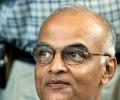
NSA Menon's wisdom says that the idea to be superpower is not really desirable, it is better to be different. Sheela Bhatt reports.
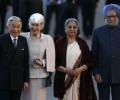
In recent years India-Japan relations have acquired rich economic content and strategic intents. Although the bilateral trade at $18 billion between the two countries is not very impressive and leaves much to be desired, the economic engagement between the two countries is both qualitatively and quantitatively noteworthy. India-Japan defence cooperation, however, has generated a lot interest among the strategic community in the context of rise of China. There has been a lot of speculation about India-Japan strategic partnership to hedge China, says Rup Narayan Das.

20 years ago this day, May 11, 1998, India conducted its second nuclear test at Pokharan in Rajasthan. In a fascinating interview on Rediff.com, K Subrahmanyam revealed how Indian PMs reacted to nuclear ambitions.
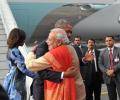
'A three generation US-Pakistan relationship is not likely to be snapped any time soon. All this presents an irritant to an India that wishes to concentrate on economic development,' says Colonel Anil A Athale (retd).

'Even if such a thing happens, it will not prolong for many days like Doklam did.' 'That is because both the leaders do not want it.'

This is the joint statement issued by the ministry of external affairs on the visit of US President Barack Obama to India.
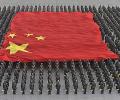
The sudden proximity between India and US has, in the eyes of many, sidelined China. This is not the case, argues Colonel Anil A Athale (retd).

Swaraj said there is scope to do a lot more and this would be an important element of their deliberations.
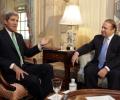
Pakistan Prime Minister Nawaz Sharif continues his exhortation for US mediation in Kashmir, and harks back to his meeting with former Prime Minister Atal Bihari Vajpayee when the latter had agreed to a resolution of Kashmir imbroglio; senior us officials assert there is 'absolutely no change in us policy' that Kashmir has to be resolved bilaterally. Aziz Haniffa reports.

'Young IFS officers today would take it for granted that they represent a major country with strengths and capabilities.' 'They will be aware that India is seen as one of the 10 significant countries in the world and therefore their voice will be heard whether on climate change or regime change,' says Ambassador B S Prakash.

The choice before the next government is not between being a soft State and a tough State; it is between being a smart State and a dumb State, says former foreign secretary Shyam Saran.

Muzzling NGOs is unbecoming of a democracy. Self-confident democracies encourage, indeed applaud, the involvement of citizens' associations, including NGOs, in social and political decision-making and development planning. Instead, our paranoid government bullies and terrorises them, says Praful Bidwai.

'There are major implications for India. Though there was a transparently thin attempt to project the troop reduction as intended to promote peace, the downsizing is actually part of plans to streamline and strengthen the PLA, capable of defending China's national interests at home and abroad,' says Jayadev Ranade.

Moving ahead with their new mantra -- Chalein Saath Saath: Forward Together We Go -- Prime Minister Narendra Modi and United States President Barack Obama on Tuesday vowed to deepen cooperation in every sector for the benefit of global stability and people's livelihoods over the next ten years.

'Imagine for a moment that the Coast Guard was unable to stop the vessel and it reached Porbandar with its cargo/personnel and targeted the event at which the prime minister was present,' says Colonel Anil A Athale (retd).

'Despite almost $30 billion of funding since 2001, all the US reaps today is unmitigated hostility of a Pakistan emboldened to flaunt its China card.' 'How can the US give credence to any offers from Pakistan, which has trotted out the standard alibi of non-State actors time and again, including dreaded terror outfits being out of State control, Pakistan itself being a victim and so forth?'
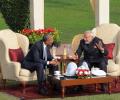
'When George Bush Senior decided in 1992 that India and the United States must start talking in this-now-changed world, who would have thought that 10, 15 years down the road, we will start looking at each other as strategic partners?'

'Children should be brought up connected to our culture and should be introduced to characters from our mythologies. What is this Baa Baa Black Sheep?'

How will the return of a majority government at the Centre, the new India-US friendship and the Mangalyaan triumph change India?

Thousands of people have lost their lives and thousands more displaced in the violence in South Sudan. The United Nations mission and humanitarian agencies are under strain to protect camps and to provide internally displaced persons with water, food and other emergency relief. What flared up as a political conflict in South Sudan is now assuming an ethnic character.
'No amount of economic measures or prosperity in Kashmir will make any dent in the situation there. The average Kashmiri understands the Pakistani game and is unlikely to prefer Pakistan over India. But the Pakistanis have made clever use of religious symbols and slogans to force religious-minded Kashmiris to support them. India has failed to counter this posturing by the separatists,' says Colonel Anil A Athale (retd).

'It was China's rise that caused the New Cold War in Asia as it prompted the United States to rebalance its forces in Asia to experiment with engagement and containment at the same time,' says T P Sreenivasan.

'China's excessive military aid to Pakistan is the real elephant in the room as far as Sino-Indian relations are concerned. India should be confident enough to accept a degree of closeness between China and Pakistan, since China may wish to use this link for its foray into the Muslim world.' 'But the Chinese must be realistic enough to know that as time passes, the tactic of using Pakistan as a proxy to check India will yield diminishing returns. The US tried it for 60 years but failed, so will China,' says Colonel Anil A Athale (retd).

It is easy to foretell that negotiating a comprehensive and final agreement on the Iran nuclear issue is by no means an easy task. It involves hard negotiations, but the hardest step has been taken, says Ambassador M K Bhadrakumar, who was among the first group of foreigners to visit the the top-secret Arak plant hidden behind barren mountains south of Tehran.
